The Prompt
An oil painting image. Retain the core biometric identity and facial likeness of the subject from the input image, BUT dynamically adapt their facial expression, emotion, hairstyle, and styling to perfectly match the mood, era, and aesthetic of this new scene. The lighting, shadows, skin tones, and texture of the face MUST adapt and blend seamlessly with the newly generated body, neck, jawline, and surrounding ambient environment for a flawless, unedited photorealistic transition. A regal portrait rendered as a timeless fine-art masterpiece, luxurious historical garments with embroidered details, rich color palette, dramatic candlelit ambiance, textured canvas surface, thick impasto brushwork, museum-grade realism, deep shadows, glowing highlights, classical composition, richly layered paint textures, elegant varnished finish, extraordinary artistic depth and craftsmanship --ar 4:5
What This Prompt Creates
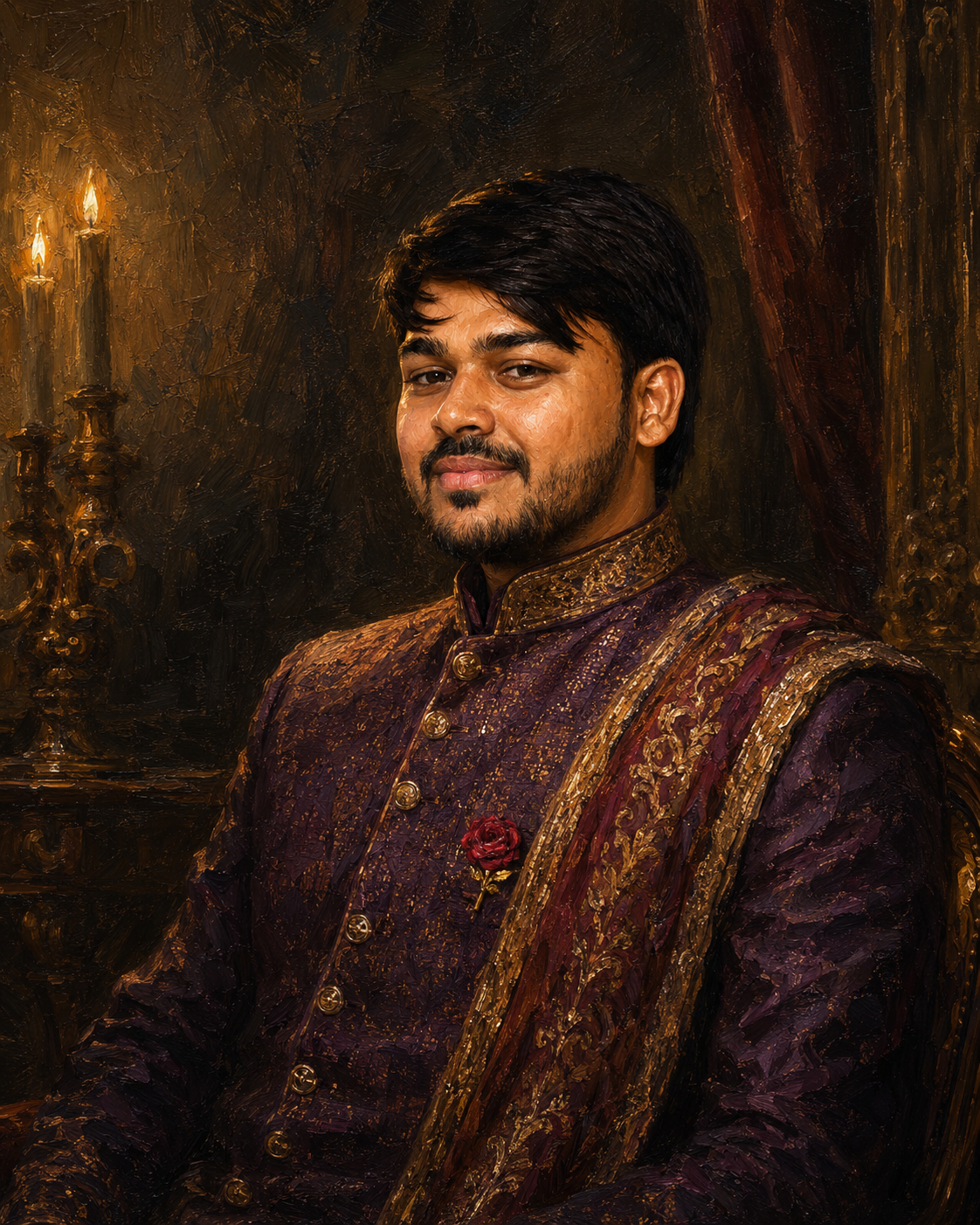
The output above would not look out of place hanging in the Mughal Gallery of the National Museum, New Delhi. This is a museum-grade regal portrait — your face rendered in the tradition of Indian royal court painting fused with European Baroque oil technique.
The purple Nehru jacket from the original engagement photo has been elevated into a full royal sherwani — deep aubergine silk with heavy gold zari embroidery running along every edge and panel, the red rose boutonnière still present on the left chest as a personal detail. The figure is seated in a classical portrait posture — confident, composed, the posture of someone accustomed to being painted.
The setting is everything a regal portrait demands: a golden candelabra with three lit candles on the left, their warm amber flames providing the primary light source; a deep crimson velvet curtain drape on the right; and a dark, richly toned background painted with the loose gestural brushwork of a master who knows that backgrounds serve the face, not compete with it.
The canvas surface texture is visible throughout. The impasto brushwork — paint applied thickly, leaving three-dimensional ridges — catches the light differently at different viewing angles. This is not a digital simulation of a painting. This is a painting.
The Craft Behind the Output
Impasto Technique
"Thick impasto brushwork" is the defining instruction for this prompt. Impasto is the oil painting technique where paint is applied so thickly it creates a physical relief on the canvas — ridges, peaks, and texture that can be felt with a finger. It is the technique of Rembrandt, Van Gogh, and Caravaggio — the painters who gave their subjects physical presence on the canvas.
In the output, the impasto is most visible on:
- The gold embroidery of the sherwani — each thread catches its own highlight
- The candle flames — raised peaks of yellow and white paint
- The dark background — thick layered brushstrokes in deep brown and black
- The curtain drape — heavy ridges of crimson paint suggesting the weight of velvet
Candlelight Physics
"Dramatic candlelit ambiance" produced technically correct candle lighting: warm amber illumination radiating from the left candelabra, falling off rapidly with distance, creating deep shadows on the right side of the face and the background. The gold embroidery catches points of candlelight — bright pinpricks of highlight that make the sherwani glow like it is made of actual gold thread.
This is chiaroscuro — the Italian technique of extreme light and shadow — applied to an Indian royal portrait context. Caravaggio in the Mughal court.
The Varnished Finish
"Elegant varnished finish" gives the painting its depth — that characteristic oil painting quality where colours seem to glow from within. Traditional oil paintings are varnished after drying to protect the surface and deepen the colours. The varnish creates a slight sheen and makes dark colours appear darker, rich colours appear richer. ChatGPT simulates this in the output: the deep purples of the sherwani have that characteristic varnished depth, and the candlelight reflections have a luminous quality that only varnished oil achieves.
The Classical Composition
"Classical composition" places the subject at the centre of the frame, three-quarter turned, with the candelabra balancing the composition on the left and the curtain providing vertical structure on the right. This is the standard composition of every regal portrait painted between 1600 and 1900 — from Holbein's Henry VIII to Raja Ravi Varma's Indian royals. ChatGPT has absorbed centuries of portrait painting tradition and applied it here.
How to Use This Prompt
ChatGPT GPT-4o
- Upload your photo to ChatGPT
- Copy the complete prompt above and paste alongside your photo
- Send — regal oil painting generation takes 35–50 seconds due to the detail level
- Download at full resolution — this image is print-ready at large sizes
To specify Indian royal styling:
Add before --ar 4:5:
"The garments should be a Mughal-era royal sherwani with gold zari work, pearl buttons, and a silk dupatta over the left shoulder"
To specify a European Baroque style instead: Add: "European Baroque court portrait — Velázquez style, Spanish royal court attire, silk doublet with lace collar, Seville palace interior"
For a darker, more dramatic result: Add: "increase the drama — deeper shadows, more extreme chiaroscuro, only the face and gold embroidery catching the candlelight, everything else in near-darkness"
For a brighter, more colourful palette: Add: "warm daylight through a palace window replacing candlelight, richer more saturated colours, Mughal miniature-influenced colour palette"
Royal Portrait Variations
Mughal Emperor
Add: "full Mughal emperor regalia — elaborate turban with a feather and jewel, multiple pearl and emerald necklaces, armband and rings, holding a ceremonial sword, Mughal court background with marble jali screens and garden glimpse"
Rajput Warrior Prince
Add: "Rajput warrior prince attire — armour with embossed metalwork, a curved talwar at the side, dark dramatic background with hints of a desert fortress, Rajput court portrait tradition, strong heroic posture"
Victorian Gentleman
Replace Indian garments with: "Victorian gentleman's formal attire — tailcoat and waistcoat, white cravat, gold pocket watch chain, Mahogany study background with hunting trophies and maps, British colonial-era portrait tradition"
Ottoman Sultan
Replace with: "Ottoman court regalia — elaborately embroidered kaftan in deep jewel tones, large turban with an aigrette feather and ruby, throne with elaborate tilework visible, Istanbul palace background, Ottoman portrait tradition"
Renaissance Noble
Replace with: "Italian Renaissance noble portrait — rich velvet doublet, fur-trimmed overgarment, classical columns in the background, a letter or book in hand, Leonardo da Vinci compositional style, Florentine noble aesthetic"
Why This Is the Most Gifted AI Portrait Style
The regal oil painting portrait has become the most-requested AI portrait for gifting for three reasons:
1. It feels permanent A digital photo lives on a phone screen. An oil painting portrait — even a printed reproduction of an AI-generated one — feels like an heirloom. It communicates: this person matters enough to be painted.
2. The Indian cultural resonance India has a deep tradition of royal portraiture — from Mughal court paintings to Raja Ravi Varma's oleographs that hung in middle-class Indian homes throughout the 20th century. A regal oil painting portrait in the Indian tradition triggers cultural memory and emotional response that a generic portrait cannot.
3. The wedding and engagement gifting opportunity This specific prompt — applied to an engagement photo like this one — creates the perfect wedding gift:
- Print on canvas at 50×70cm
- Frame in a dark wood or gold frame
- Gift as a couple's portrait for the new home
The cost: canvas print + frame. The impact: a heirloom-quality artwork that commemorates one of the most significant days of a person's life.
Printing Guide
This prompt produces the highest-resolution, most print-ready output of all the prompt categories. The impasto texture, dark background, and rich colour palette all translate beautifully to physical media.
| Print Size | Best Use | Recommended Material | |---|---|---| | 20×25cm | Desk frame, gifting | Matte fine-art paper | | 30×40cm | Bedroom or study wall | Canvas with gallery wrap | | 50×70cm | Living room statement piece | Canvas, float-mounted | | 70×100cm | Hallway or reception wall | Canvas, heavy frame |
Recommended canvas print services in India: Canvaswala, Printingbaaz, Zoomin Canvas, Canvera.
Posting Strategy
Caption for Instagram:
"If history had a portrait of me, this would be it. 🖼️ One ChatGPT prompt. Prompt in bio."
Or for gifting context:
"The most personal gift you can give someone in 2026 — their own oil painting. Zero artist required."
Or for cultural pride:
"Mughal energy. ChatGPT understood the assignment. 👑"
Best hashtags:
#OilPainting #RegalPortrait #MughalArt #ChatGPTArt #RoyalPortrait #AIArt #IndianRoyal #ClassicalPortrait #PromptVault #AIPhotoEditing
Frequently Asked Questions
Q: Why did ChatGPT turn the Nehru jacket into a sherwani? "Luxurious historical garments with embroidered details" combined with the visual context of the source photo (Indian subject, formal occasion, purple outfit) prompted ChatGPT to generate the Indian royal equivalent — a full embroidered sherwani. The AI selected the garment that best matched the cultural context of the subject and the regal portrait instruction.
Q: The red rose from the original photo is still on the chest — was that intentional? The face retention instructions preserve all prominent identity details from the source photo. The rose boutonnière was a distinctive detail in the original image, and ChatGPT retained it as a personal identifier — translating it seamlessly into the sherwani context. This is the AI maintaining identity continuity across the transformation.
Q: Can I print this and it will look like a real oil painting? Yes — canvas printing of this image at 50×70cm or larger produces a result that looks remarkably like an actual painted canvas, especially with the impasto texture that catches light differently at different angles. Add a gallery-wrap canvas mount for maximum effect.
Q: How do I get a couple's royal oil painting portrait? Upload a couple's photo and add to the prompt: "both figures in the portrait — the man and woman side by side in matching royal attire, classical double portrait composition".
Q: Want a custom regal portrait prompt for a specific Indian royal tradition, wedding occasion, or gifting purpose? Follow us on Instagram or join our Telegram and DM your photo — we create free custom royal portrait prompts for weddings, anniversaries, and milestone occasions.