The Prompt
A watercolor image. Retain the core biometric identity and facial likeness of the subject from the input image, BUT dynamically adapt their facial expression, emotion, hairstyle, and styling to perfectly match the mood, era, and aesthetic of this new scene. The lighting, shadows, skin tones, and texture of the face MUST adapt and blend seamlessly with the newly generated body, neck, jawline, and surrounding ambient environment for a flawless, unedited photorealistic transition. A deeply emotional portrait painted on textured cotton paper, elegant flowing garments, soft atmospheric surroundings, delicate pigment blooms, translucent watercolor washes, subtle ink outlines, graceful color bleeding, artistic splashes and layered brushwork, poetic composition, luminous pastel palette, handcrafted fine-art quality, expressive storytelling through light and texture, museum-worthy watercolor illustration --ar 4:5
What This Prompt Creates
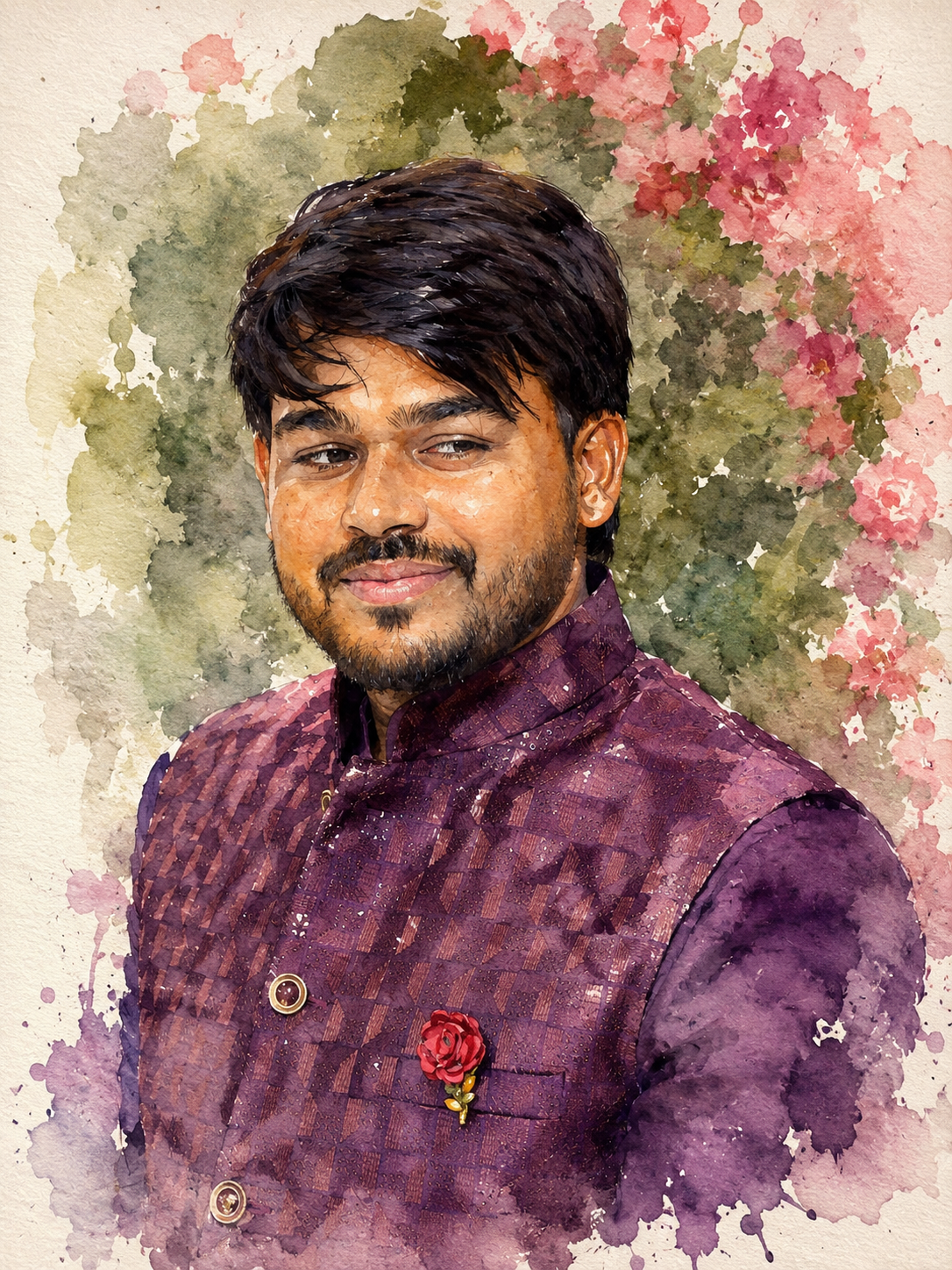
The output above is a museum-quality watercolor portrait that carries the emotional weight of a painting made by someone who knew the subject well and loved them. Your face — beard, smile, features — is painted with the clarity and warmth of a master watercolorist. The purple Nehru jacket is rendered in deep violet and aubergine washes, the red rose boutonnière glows vivid and precise against the softer surrounding tones. And behind the figure: the original floral wall from the engagement ceremony is reborn — pink roses and green foliage dissolving into soft background washes that frame the portrait with botanical warmth.
ChatGPT made a remarkable compositional decision here. The source photo had a floral wall backdrop. Rather than replacing it entirely, the AI translated it into the watercolor medium — the flowers remain, but they are now painted, loose, bleeding at the edges, as if the original wall became a painting. The visual memory of the engagement ceremony is preserved, transformed into something timeless.
The Watercolor Craft in This Image
Cotton Paper Texture
"Painted on textured cotton paper" produces the foundation of every other quality in this image. Watercolor cotton paper (300gsm, cold-pressed) has a characteristic tooth — a slight surface roughness that breaks up washes, creates granulation in pigments, and makes brush marks visible. The output shows this texture throughout: you can see the paper grain under the thin washes in the background, the way the purple pigment settles unevenly into the paper's texture across the jacket.
This paper quality is what separates fine art watercolor from commercial illustration. ChatGPT renders it correctly.
Translucent Layered Washes
"Translucent watercolor washes" + "graceful color bleeding" produces the defining quality of watercolor as a medium: you can see through every layer to the layers beneath. In the output:
- The jacket is built from multiple overlapping purple-violet washes — each one transparent, the ones beneath glowing through
- The background foliage is layered green washes with pink roses painted on top, each colour visible through the others
- The skin tones are warm transparent flesh washes over the white of the paper — the paper itself provides the lightest light
No other painting medium works this way. Oil, acrylic, gouache — they are all opaque. Watercolor is built from controlled transparency, and this is what gives the output its luminosity.
Ink Outlines
"Subtle ink outlines" adds the second defining element of fine-art watercolor illustration: a light ink drawing beneath (or over) the washes that defines structure without constraining the looseness of the paint. In the output, fine ink lines define the beard, the eyes, the collar of the Nehru jacket, and the red rose — just enough to anchor the form while the surrounding washes remain free.
This combination of ink structure + watercolor wash is the technique of the great Indian watercolor illustrators — the tradition that ran from the Bengal School through to contemporary Indian fine art.
The Pigment Blooms
"Delicate pigment blooms" — also called cauliflower effects or backruns in watercolor technique — occur when wet paint flows back into a wash that is partially dry, creating irregular flower-like patterns. In the output these are visible at the edges of the background washes — particularly where the green foliage meets the cream paper, creating those soft irregular edges that signal genuine watercolor behaviour. They cannot be faked with any other medium. ChatGPT renders them correctly.
The Colour Splashes
At the bottom corners and edges of the image, there are deliberate watercolor splashes — drops of violet and pink that extend beyond the composition. These are the signature of loose, expressive watercolor illustration — the artist's excitement spilling beyond the frame. They signal that this painting was made by someone feeling the subject, not just rendering it technically.
How to Use This Prompt
ChatGPT GPT-4o
- Upload your photo to ChatGPT
- Copy the complete prompt above and paste alongside your photo
- Send — fine-art watercolor generation takes 30–40 seconds
- Download at full resolution — ready for canvas or fine-art paper printing
To make it more abstract: Add: "increase the paint bleeding and abstraction — the background should be completely non-representational colour fields, only the face retaining any detail"
To add more ink structure: Add: "stronger ink outlines — the entire figure outlined in confident black ink over the washes, graphic novel meets fine-art watercolor"
For a cooler palette: Replace "luminous pastel palette" with: "cool palette — soft prussian blue, lavender, silver, moonlight whites — a night-time watercolor"
For a darker, moodier result: Add: "dark and dramatic watercolor — deep Payne's grey washes, minimal colour, the face emerging from near-darkness, Romantic era emotion"
Style Variations
Ink & Wash Sketch
Add: "loose gestural ink line drawing quality — the figure sketched in confident pen strokes with minimal color washes filling in, travel journal illustration style, spontaneous and immediate"
Japanese Sumi-e
Replace Western watercolor with: "Japanese sumi-e ink wash painting — minimal brush strokes, negative space as a compositional element, monochrome ink with one accent colour for the rose, Zen simplicity, rice paper texture"
Botanical Illustration
Add: "detailed botanical illustration style — the surrounding flowers painted with scientific botanical accuracy, each petal and leaf precisely rendered, Royal Botanic Gardens illustration tradition"
Monsoon Palette
Replace luminous pastel with: "monsoon India palette — deep indigo, wet earth tones, rain-grey greens, warm terracotta, the colours of the Indian monsoon season, deeply emotional and nostalgic"
Rajasthani Miniature Fusion
Replace Western watercolor with: "Indian Rajasthani miniature painting fusion — flat perspective, jewel-toned colours, intricate border pattern, patterned background, the subject in traditional attire, Jaipur school tradition"
The Emotional Intelligence of This Output
What makes this watercolor portrait exceptional is something beyond technical execution: the emotional continuity between the source photograph and the painting.
The original photo was taken at an engagement ceremony — a moment of joy, anticipation, and emotional significance. The watercolor output preserves that emotional register. The expression is warm and present. The roses from the original floral wall return as painted flowers — a visual memory carried forward. The red rose boutonnière remains, now glowing with the jewel-bright intensity that watercolor gives to small areas of concentrated colour.
This is what the prompt instruction "expressive storytelling through light and texture" produces: a painting that doesn't just render a face, but communicates something about the moment the face was captured. The technique serves the emotion.
Watercolor has always been the medium of personal feeling — the medium of letters, diaries, travel sketchbooks, and love notes. It is intimate in a way that oil painting is not. This portrait feels like it was made by someone close to the subject, for someone close to the subject.
The Perfect Gift
This watercolor portrait is the single best prompt on PromptVault for gifting purposes, for reasons that the other categories cannot match:
For an engagement or wedding gift: The source photo is an engagement photo. The output painting contains the original roses from the engagement backdrop. The red rose boutonnière remains. This is an engagement memory transformed into a permanent piece of art — something that can hang on the wall of the couple's home for decades.
For a birthday or anniversary: A watercolor portrait has the emotional register of a handmade gift. It communicates care, thoughtfulness, and personal attention in a way that a commercial purchase cannot.
For parents of the couple: Parents of Indian grooms and brides receive hundreds of digital photos after an engagement. A single watercolor portrait — printed on art paper, framed — is something different: a physical object with permanence and beauty that digital photos cannot achieve.
Printing for Gifting
| Format | Size | Material | Framing | |---|---|---|---| | Desk piece | 15×20cm | 300gsm cotton art paper | Light wood float frame | | Wall piece | 30×40cm | Canvas or fine art paper | Dark wood, off-white mount | | Statement piece | 50×70cm | Canvas gallery wrap | No frame needed |
Posting Strategy
Caption for Instagram:
"Some moments deserve to be painted, not just photographed. 🌸 One ChatGPT prompt."
Or for the art angle:
"ChatGPT made a watercolor of me and I don't know how to process it emotionally."
Or for the engagement/wedding context:
"The flowers from that day never left. 🌹 Prompt in bio."
Why watercolor AI content saves the most: Of all the AI portrait styles, watercolor consistently has the highest save rate on Instagram and Pinterest because:
- It looks like something that took skill and effort — people save it thinking "I could give this as a gift"
- The romantic, emotional quality triggers a save response in the way that dramatic or technical styles do not
- It is perceived as personal — a painting feels made for someone, not generated for everyone
Best hashtags:
#WatercolorPortrait #WatercolorArt #ChatGPTArt #AIWatercolor #PortraitArt #WatercolorPainting #AIPhotoEditing #ArtGift #PromptVault #ChatGPTPrompt
Frequently Asked Questions
Q: Why did the background return to flowers when the prompt doesn't mention flowers? ChatGPT carried the visual context of the source photo forward. The original photo had a pink and white floral wall backdrop — the AI recognised this as a significant visual element and translated it into the watercolor medium as soft botanical washes. This is contextual visual memory — the AI doesn't discard what was there, it transforms it.
Q: What makes cotton paper texture different from regular paper in AI watercolor prompts? Specifying "textured cotton paper" tells ChatGPT to apply the specific surface grain of professional watercolor paper — the uneven tooth that breaks up washes, creates granulation, and makes brush marks visible in a characteristic way. It is the detail that separates a fine-art watercolor rendering from a generic soft-filter effect.
Q: Can I print this on actual watercolor paper? Yes — fine-art giclée printing services can print digital images onto 300gsm cotton watercolor paper, producing a result that is genuinely difficult to distinguish from a hand-painted original. This is the highest-quality printing option for this type of AI output.
Q: Can I get a couple's watercolor portrait — both people in the same painting? Yes — upload a couple's photo and add: "paint both figures together in the composition, their colours and the botanical elements weaving between them".
Q: Want a custom watercolor prompt for a specific occasion, colour palette, or painting style? Follow us on Instagram or join our Telegram and DM your photo — we'll create a free custom watercolor prompt for your exact moment, palette, and purpose.